
← Case Studies
YIVO Encyclopedia of Jews in Eastern Europe
Translating Expertise into an Experience Anyone Can Explore
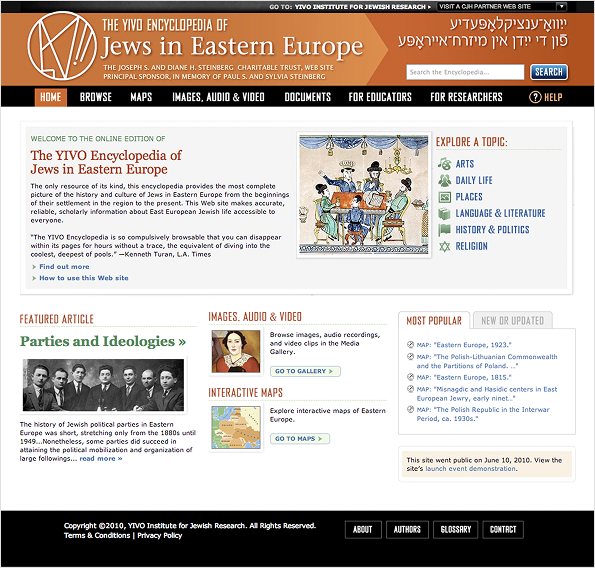
Overview
During the years I ran my own design studio, I had the opportunity to work across an unusually broad range of industries—from educational publishing and travel to healthcare, engineering, nonprofits, and consumer software.
One project stands out not only because of its scale, but because of how much it shaped how I think about design leadership.
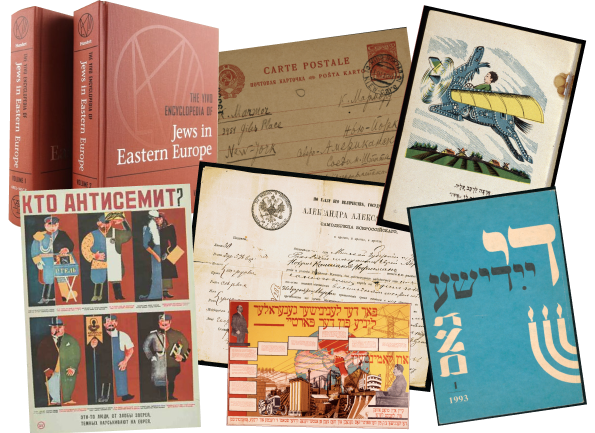
The YIVO Encyclopedia of Jews in Eastern Europe was a 2,400-page scholarly reference work containing more than 1,800 articles, over 1,000 illustrations, and contributions from 450 historians and researchers. The organization wanted to transform this monumental print publication into an online experience that could serve both academic scholars and the general public while becoming the flagship digital presence for the institute.
At the start of the project, I knew very little about Eastern European Jewish history. By the end, I had learned one of the most valuable lessons of my career:
Great product designers don't need to be domain experts.
They need to become experts at understanding domain experts.
The Challenge
The project was far more ambitious than simply digitizing a book. The website needed to satisfy audiences with dramatically different goals:
- Academic researchers conducting in-depth scholarship
- University students discovering topics for the first time
- Teachers creating lesson plans
- Genealogists researching family histories
- Writers and journalists
- Casual visitors exploring history out of personal curiosity
- Potential donors discovering the organization
Each audience entered the content differently. Some knew exactly what they wanted to find. Others had no idea where to begin. The challenge became designing multiple pathways into an encyclopedia without compromising its scholarly integrity.
 My Role
After a competitive RFP process against four other firms, my studio was selected to lead the design of what would become YIVO's flagship digital product. I led the project from research through implementation, including:
- User research and discovery
- Information architecture
- Taxonomy development
- User stories and personas
- Wireframes and interaction design
- Interactive prototyping
- User testing
- Search experience design
- Interactive map design
- Multimedia presentation
- Visual design
- Collaboration with stakeholders across editorial, archival, fundraising, and technical teams
Designing Multiple Paths Into Knowledge
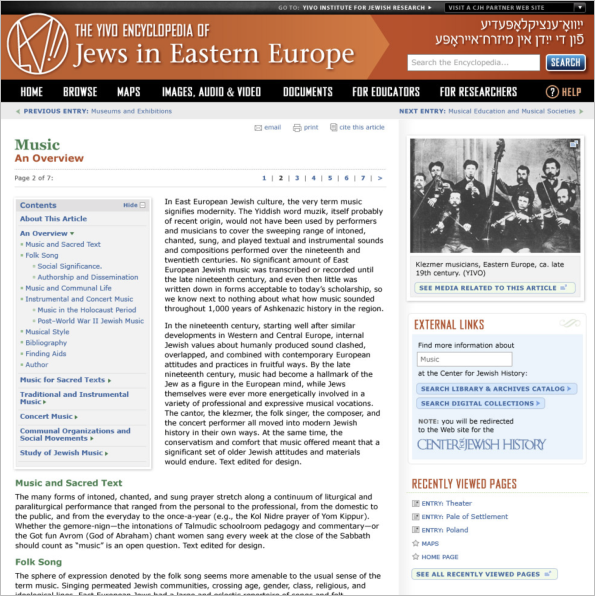
The encyclopedia contained an extraordinary amount of interconnected information. Our challenge wasn't simply making it searchable—it was making it discoverable. Instead of creating a digital book, we wanted to design an exploration platform. We created multiple ways for users to explore the material, including:
- Rich thematic articles connecting related topics
- Faceted search with weighted results
- Alphabetical browsing
- Category-based navigation
- Rich autocomplete with previews
- Interactive timelines organized by historical themes
- Interactive maps connecting places with related articles
- Audio and video integrated directly into relevant entries
- Educator resources and lesson plans
- Connections to events hosted by the Center for Jewish History
Rather than forcing every visitor into the same navigation model, we designed experiences that matched different research styles and levels of expertise.
Building the Information Architecture
One of the most important parts of the project happened long before visual design. Working closely with scholars and contributors, we developed an entirely new taxonomy for organizing the encyclopedia.
Through questionnaires, workshops, and content analysis, we identified meaningful categories that allowed users to discover related material naturally.
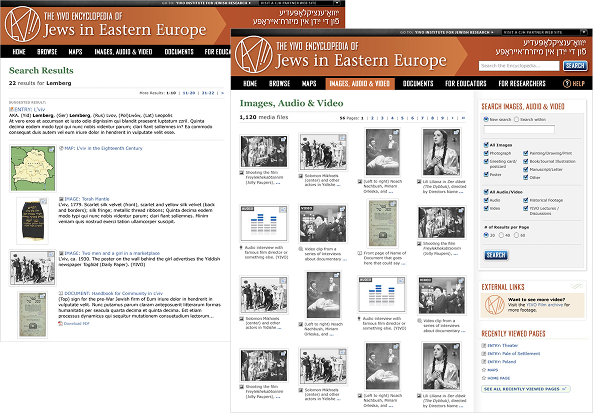
We then designed a search experience that surfaced encyclopedia articles first while also presenting related media, maps, and connected entries within the same results.
The search engine became more than retrieval—it became another way of learning.
Testing with Real Users
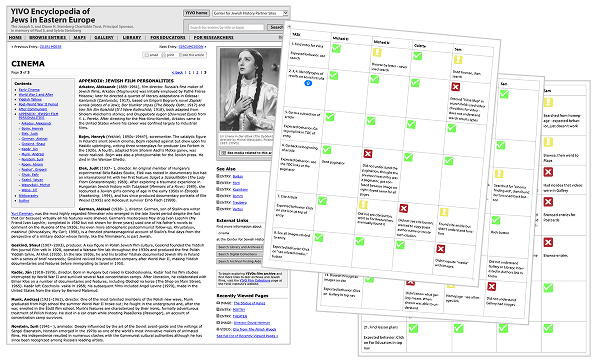
After developing interactive prototypes, I conducted usability testing with participants representing different audiences. Some users were given specific research tasks. Others were encouraged to browse freely without direction.
Those sessions confirmed an important insight:
Many of the most rewarding discoveries happened accidentally.
As a result, we strengthened thematic exploration, contextual links, and related content throughout the experience to encourage curiosity alongside purposeful research.
Bringing Print Into the Digital World
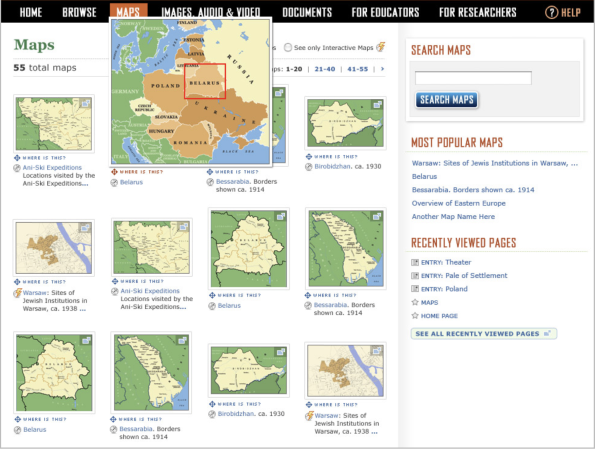
The original encyclopedia included hundreds of illustrations, maps, photographs, and multimedia assets that had been designed for print. To fully realize the online experience, with my team I:
- Redesigned static maps as scalable interactive SVG illustrations
- Created custom audio and video players
- Processed and optimized multimedia for the web
- Developed presentation systems that connected media across multiple related articles
Rather than treating multimedia as supplementary content, we integrated it directly into the research experience.
Balancing Competing Perspectives
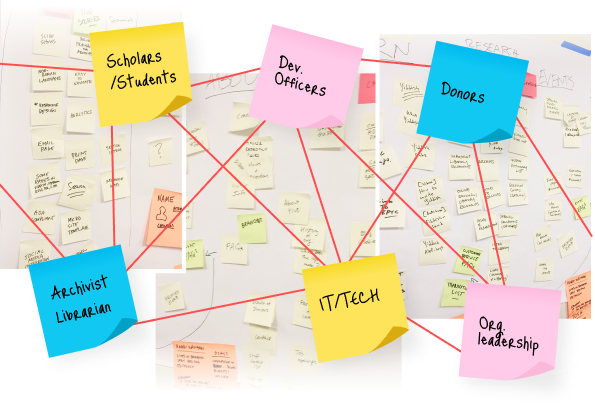
Like many institutional projects, success depended as much on communication as design. Throughout the project, I regularly facilitated discussions among stakeholders with competing priorities:
- Scholars focused on academic rigor
- Archivists and librarians debating taxonomy
- Development officers looking to increase donations
- Technical teams working within aging infrastructure
- Organizational leadership balancing long-term institutional goals
Much of my role involved finding solutions that respected each group's expertise while keeping the user experience coherent.
 Results
The project received a Webby Award for Best Education Website and earned praise from critics and educators alike.
User Impact
- Created an experience accessible to both scholars and the general public
- Made an enormous body of historical research discoverable through multiple exploration paths
- Encouraged deeper engagement through interactive content and connected information
Organizational Impact
- Delivered the institute's flagship digital presence.
- Supported fundraising and public outreach alongside academic research
- Created a sustainable foundation for future educational content
Recognition
One review captured exactly what we had hoped to achieve:
"The YIVO Encyclopedia is so compulsively browsable that you can disappear within its pages for hours without a trace, the equivalent of diving into the coolest, deepest of pools."
— Kenneth Turan, Los Angeles Times

Reflection
This project was another step in shaping how I think about product design. What I learned was that I wasn't hired because I was an expert in Jewish history:
I was hired because I could learn from people who were.
Throughout my career, I've worked in finance, healthcare, publishing, engineering, travel, education, nonprofits, and emerging technologies. Each domain has its own language, workflows, and constraints, but the process remains remarkably consistent:
- Listen carefully
- Understand the people behind the expertise
- Identify the problems they are trying to solve
- Then design experiences that make that expertise more accessible to others
For me, that's one of the most rewarding aspects of design leadership: not becoming the domain expert, but helping domain experts share what they know with the world.